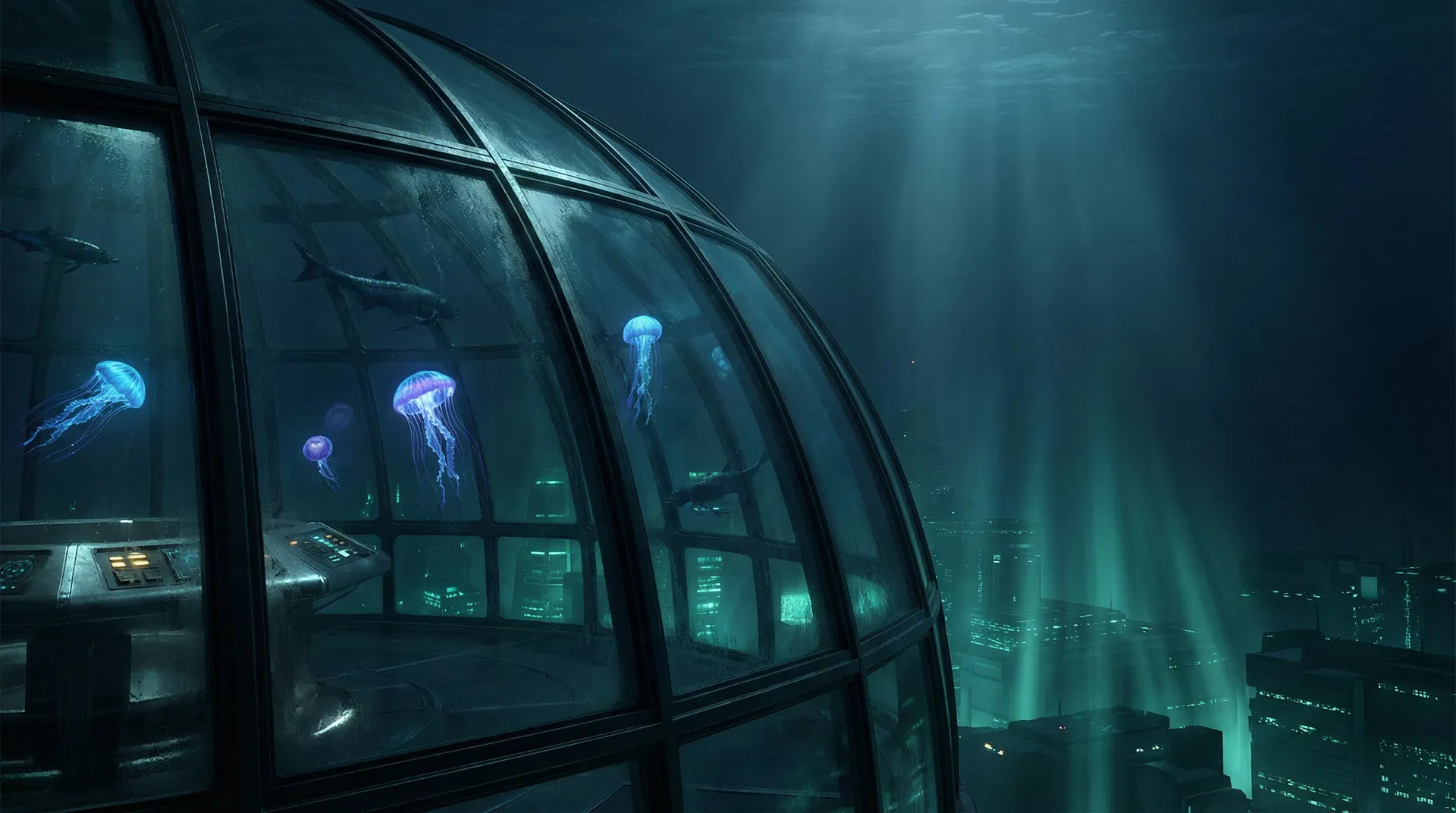
Cradle of Salvation
A global initiative for the preservation of humanity. Autonomous deep-water and lake megacities as a realistic and economically viable alternative to space colonization.
The Illusion of Space vs. The Shield of the Ocean
The Trap of Other Planets
Space is hostile. The absence of a radiation shield, microgravity (which destroys human DNA), and the colossal cost of logistics make Mars and the Moon economic dead ends. Delivering just 1 kg of cargo costs hundreds of thousands of dollars.
The Natural Bastion
Earth's hydrosphere is the perfect shield. The mass of water completely blocks radiation and shockwaves. Gravity remains familiar (1G). Construction here is thousands of times cheaper than in space.
The Real Cost: 1,000 People in Space vs. Underwater
All space figures assume the 1,000 colonists actually survive the journey — which is far from guaranteed. These are the costs IF they make it alive.
Critical Assumption
All cost estimates for space colonization below assume the 1,000 people actually survive the 6–9 month journey through lethal cosmic radiation, micrometeorite impacts, equipment failures, and the psychological toll of confinement. NASA estimates a Mars mission could carry a mortality rate of up to 50% from radiation alone. These numbers represent the best-case scenario — the cost of keeping them alive after arrival, assuming nothing goes catastrophically wrong en route.
Transportation∞ cheaper underwater
$2–10 Trillion
6–9 month journey. If they survive the radiation, microgravity, and equipment failures.
$0
Already on Earth. No launch needed. Construction materials delivered by cargo ships.
Habitat Construction5,000× cheaper underwater
$25+ Trillion
Every kilogram must be launched from Earth at $100,000+/kg. No local resources. No atmosphere.
$3–5 Billion
Uses proven deep-sea engineering (oil rigs, submarines). Local water for cooling and life support.
Annual Life Support50–80× cheaper underwater
$4–12 Billion/yr
ISS costs $11,250/person/day for life support alone. Mars would be even higher.
$75–150 Million/yr
Surrounded by water for cooling, oxygen (electrolysis), and food (aquaculture).
Mortality Risk (Transit)
5–50%
Cosmic radiation, solar flares, equipment failure, no rescue possible for 6–9 months.
~0%
No transit required. Rescue teams can reach any ocean point within hours.
Radiation Protection
Minimal
Mars has no magnetic field. 33% increase in cancer mortality after a 1,000-day mission (NASA).
Complete
Just 10 meters of water blocks all cosmic radiation. At 200m+ depth, nuclear blasts are irrelevant.
Rescue & Resupply
Impossible
4–24 minute communication delay. No rescue ship can reach Mars for months. You're on your own.
Hours
Standard maritime rescue. Real-time communication. Resupply by submarine or surface vessel.
Construction Timeline5–10× cheaper underwater
20–50 Years
Requires technologies that don't exist yet. Multiple launch windows. Decades of preparation.
3–5 Years
Based on existing deep-sea engineering. Oil industry has built structures at 3,000m+ depth.
Total 10-Year Cost for 1,000 People
Mars Colony
$65–135T
Trillion dollars. ~3–5× the entire US national debt.
* If they survive the journey
Underwater City
$4–6.5B
Billion dollars. Less than a single aircraft carrier.
* With proven technology that exists today
The underwater option is 10,000–20,000× cheaper
And it doesn't require your colonists to survive a 6-month journey through lethal radiation with zero possibility of rescue.
"If They Even Get There Alive"
Up to 50%
Estimated mortality rate from cosmic radiation on a Mars journey
0 min
Warning time before a lethal solar particle event in deep space
6–9 months
Travel time to Mars with zero possibility of turning back
+33%
Increase in cancer mortality risk after a 1,000-day Mars mission (NASA)
Even the most optimistic Mars colonization plans acknowledge that the journey itself is the most dangerous part. Cosmic rays damage DNA at the cellular level. Solar particle events can deliver lethal doses within hours. The spacecraft offers minimal shielding — adding more would make it too heavy to launch. And if something goes wrong at the midpoint, there is no rescue, no hospital, no way back. Meanwhile, an underwater habitat at 300 meters depth is reachable by rescue submarine in hours, has complete radiation shielding from the water itself, and maintains Earth-normal gravity at all times.
Two Paths to Survival
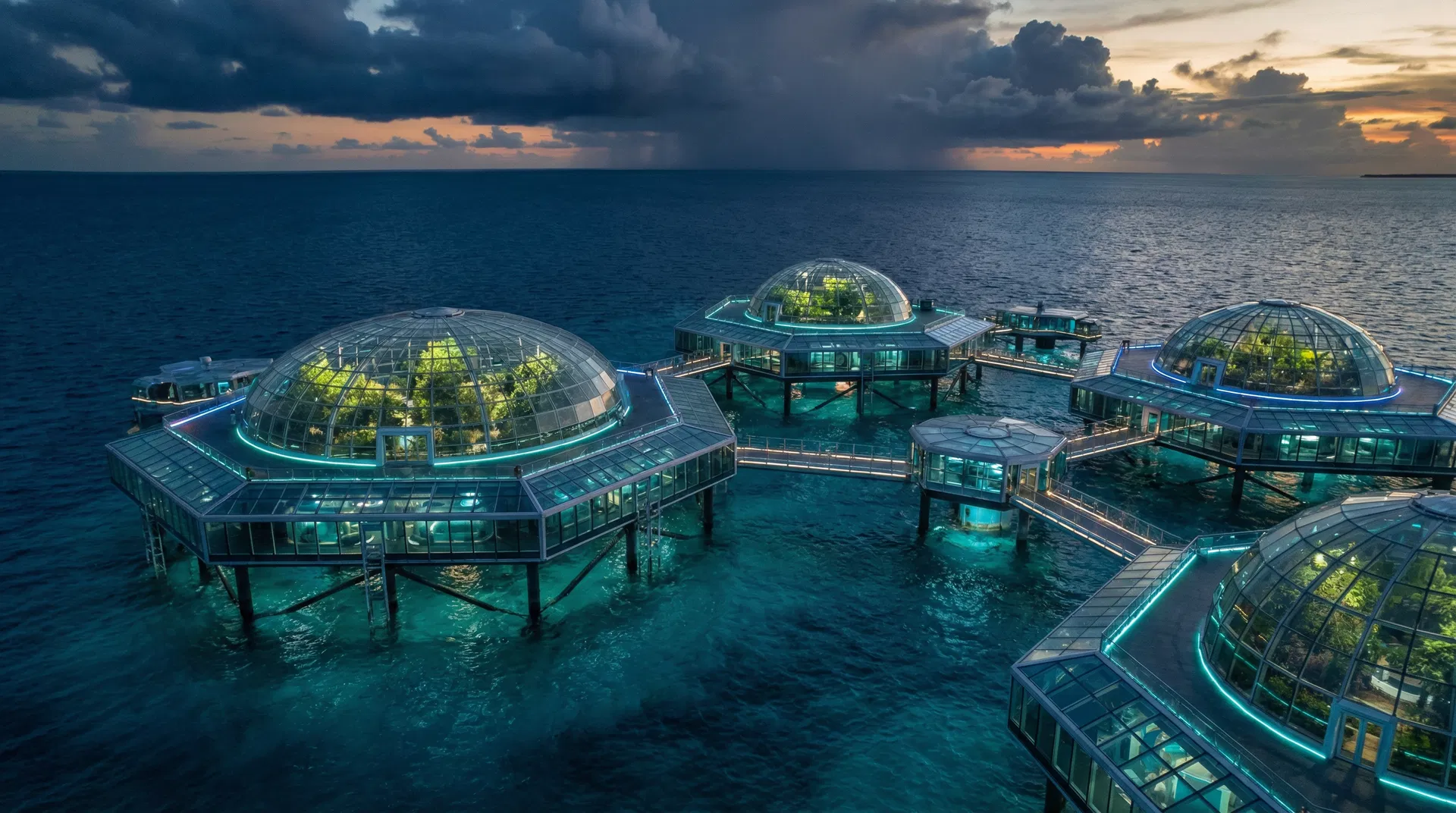
The Amphibian City
Location: Ocean surface or ultra-deep lakes (Lake Tanganyika).
Modular floating platforms. In peacetime, they drift on the surface. Under threat, they instantly submerge into the "twilight zone" (200–500 meters), escaping any surface-level catastrophe.
Read Full Details →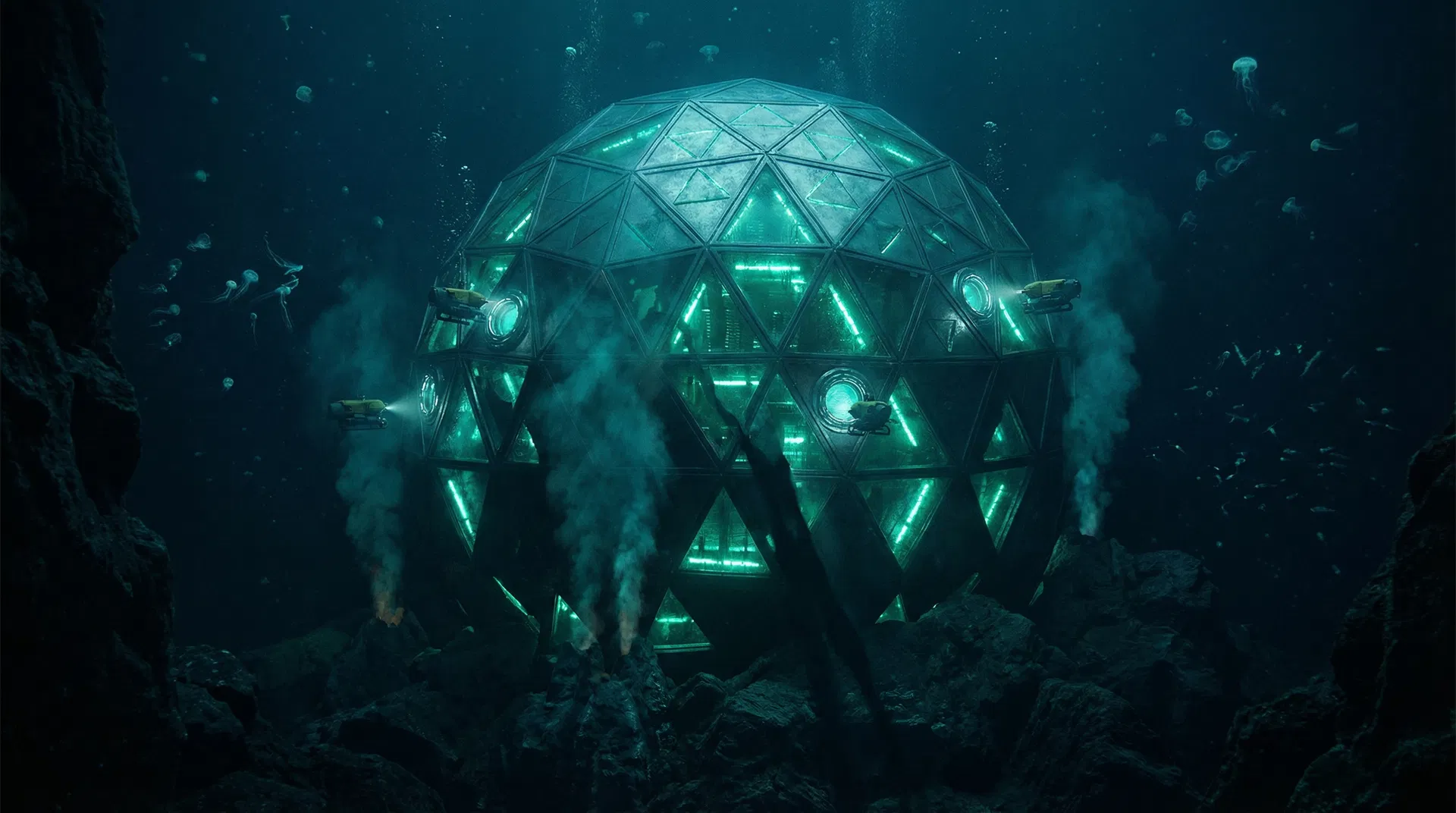
The Deep-Water Bastion
Location: Abyssal plains or Canadian crystalline shields (depth 600–3,000 meters).
The ultimate bunker made of geodesic titanium spheres. A stationary base embedded in stable geological bedrock. Designed for 100+ years of complete autonomy.
Read Full Details →Modular Architecture & Life Support
A fractal structure from a family-sized autonomous capsule to a megacity of 100,000 people.
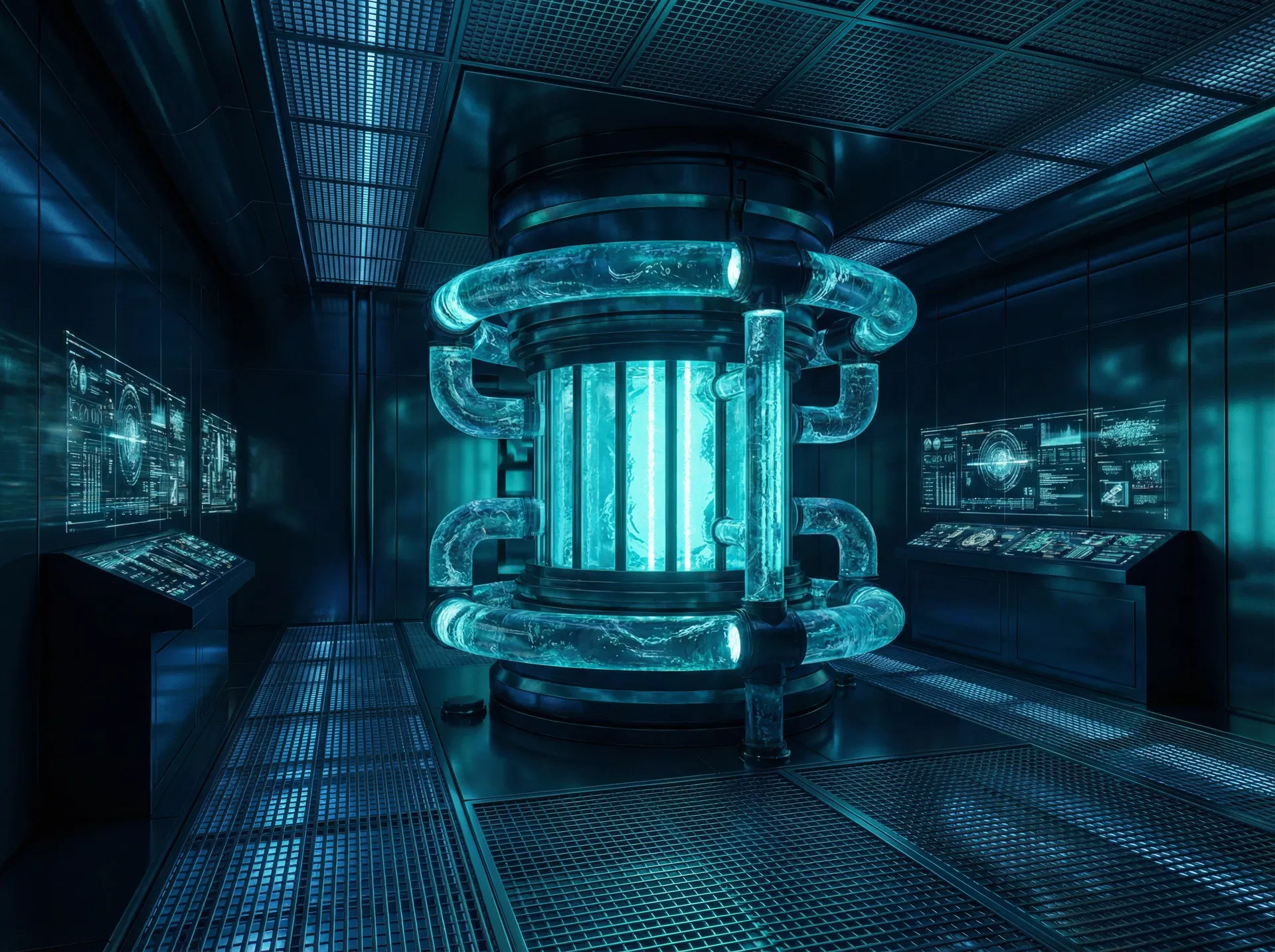
Small Modular Reactor (SMR)
The energy core of the deep-water city
Energy Hub
Small Modular Reactors (SMR) cooled by surrounding ice-cold water. Backup quantum batteries and geothermal wells on the seabed.
Breathing System
Industrial water electrolysis for oxygen extraction. Metal-organic framework scrubbers (MOF) capture CO₂ and redirect it to feed biomes.
Agro-Complex
Multi-tier hydroponics under LED sunlight. Microalgae bioreactors for protein generation and closed-loop aquaculture.
Command Center
The city's central neural network controlling pressure balance, airlocks, and resource distribution.
Protective Hull
Geodesic titanium spheres withstanding pressure at 3,000m depth. Multi-layer insulation and self-healing polymers.
Medicine & Society
Special focus on mental health in isolation: parks, virtual windows streaming Earth landscapes, schools, and knowledge archives.
Investment Calculator
Location: Ocean (Abyssal)
Construction (CapEx): $17.3B
Annual Maintenance (OpEx): $432M
Location: Freshwater Lake
Construction (CapEx): $11.4B
Annual Maintenance (OpEx): $136M
Required Energy Capacity (SMR): 42.0 MW
Become Part of History
We are not just building a bunker. We are developing zero-emission, closed-loop, and autonomous technologies that will begin generating returns immediately after construction.
Deep Dive
Explore each topic in depth. Every page contains detailed technical analysis from our engineering documentation.