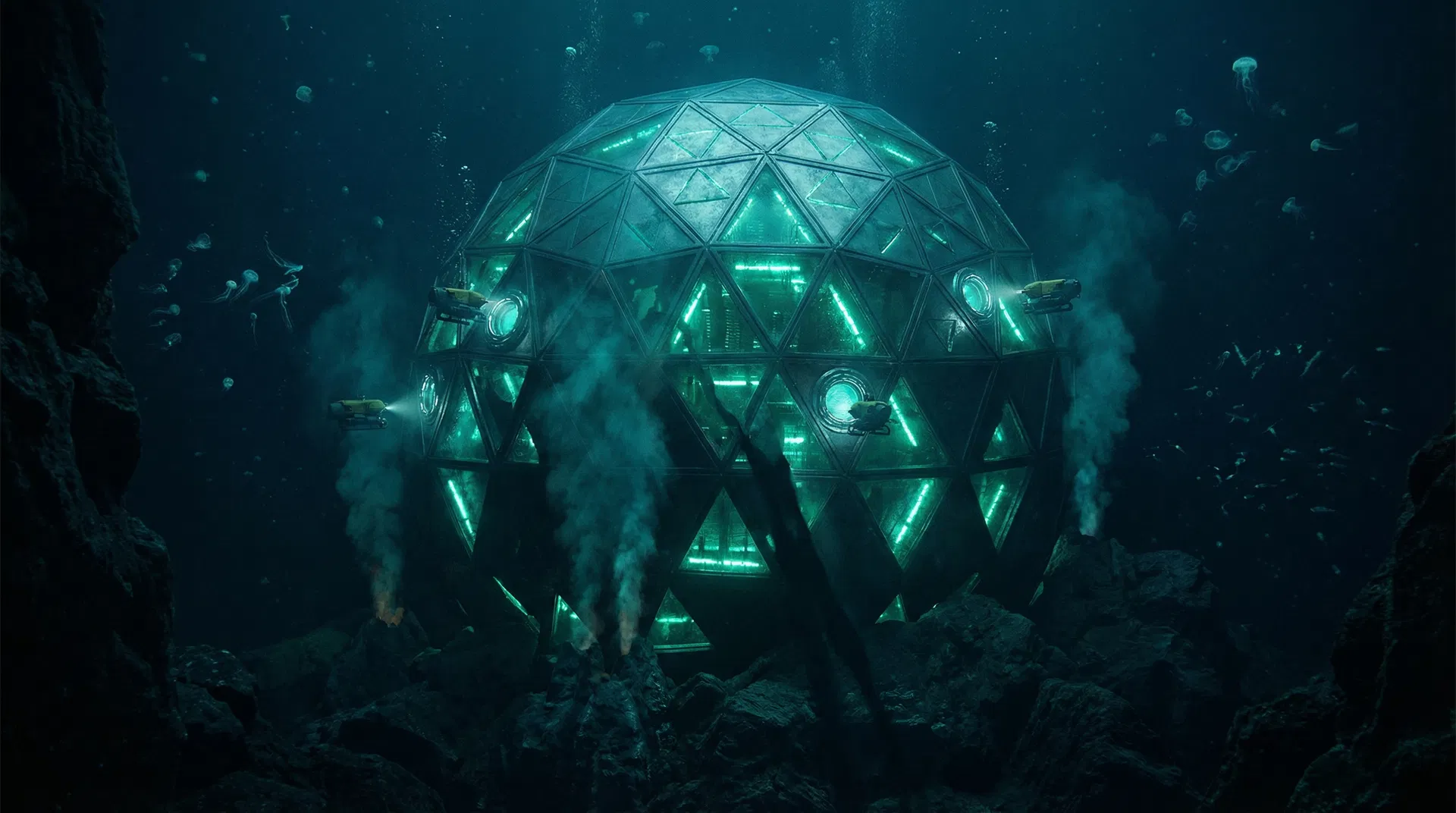
Concept B
The Deep-Water Bastion
Philosophy of the Concept
This is not a temporary shelter. It is a closed-cycle civilization designed for 100+ years of autonomous survival without any contact with a scorched or frozen surface. A city embedded in the most stable geological formations on Earth, under a gigantic water column that shields against everything the universe can throw at it.
2,000–3,000m
Operational depth (ocean)
100+
Years of full autonomy
100,000
Population capacity
200–300 atm
Pressure resistance
Honeycomb Architecture of the Depths
Unlike the floating platforms of the Amphibian, the Bastion uses exclusively connected geodesic spheres — the ideal geometric form for resisting colossal pressure.
Geometry of Spheres
Spherical and toroidal modules distribute water pressure evenly across their entire surface, eliminating stress concentration points. Modules are connected by flexible hermetic tunnels that compensate for micro-seismic shifts.
The sphere is the strongest possible shape against external pressure — the same principle used in deep-sea submersibles that reach the Mariana Trench.
Module Arrangement
Living Spheres (Family Blocks): Positioned on the outer ring with virtual window-screens projecting calming Earth landscapes — forests, mountains, sunsets — for psychological comfort.
Life Core (100+ people per block): Enormous central domes housing multi-tier hydroponic farms, parks with synthetic UV lighting for vitamin D production, and advanced filtration systems.
The entire structure maintains Earth-normal gravity (1G) — no centrifuge needed. We are on Earth, not in orbit.
Energy & Total Autonomy
The Bastion is designed for complete independence from the surface. Every system is redundant, every resource is recycled.
Power Generation
The primary energy source is next-generation Small Modular Reactors (SMR) — compact nuclear reactors being developed in the USA, Canada, and France. Cooled by the surrounding ice-cold water, they can power an entire megacity for 50+ years without fuel reloading.
Secondary power comes from geothermal installations — wells drilled directly into the ocean floor beneath the city, tapping the Earth's crust heat. No solar panels, no wind turbines — the Bastion is independent of surface weather and daylight.
Closed-Loop Life Support
Atmosphere: Oxygen extracted from water via industrial electrolysis. CO₂ exhaled by residents is captured by MOF scrubbers and redirected to hydroponic farms as plant food. Nothing is wasted.
Food: Closed biomes with aeroponics and hydroponics for vegetables and grains under LED lighting. Massive aquaculture farms breeding protein-rich algae and deep-water fish.
Waste: Pyrolysis installations convert any non-biological waste (plastic, synthetics) into basic chemical elements for reuse. The cycle is 100% closed.
Location Selection: Safe Ocean Zones
The Bastion must be placed on abyssal plains — flat, deep ocean floor areas far from tectonic plate boundaries and continental edges to avoid underwater landslides.
Central Pacific Basin
One of the most seismically stable places on the planet. Far from any tectonic plate boundary. The flat abyssal plain provides an ideal foundation for a permanent installation at 2,000–3,000 meters depth.
Argentine Basin (Atlantic)
An enormous plain with a very calm geological setting. Remote from volcanic activity and subduction zones. The stable sediment floor provides excellent anchoring for permanent structures.
South Australian Basin
Remote from all subduction zones where tectonic plates collide. The geological stability of this region has been maintained for millions of years, making it an ideal candidate for century-scale installations.
Great Slave Lake (Canada)
The freshwater alternative. Depth 614 meters on the Canadian crystalline shield — one of the most ancient, monolithic, and geologically stable platforms on Earth. Earthquakes practically never occur here.
600 meters of fresh water blocks cosmic radiation, dampens blast waves, and protects from century-long glaciation. Engineering is orders of magnitude cheaper than deep ocean.
Engineering the Impossible: 200–300 Atmospheres
At 2,000–3,000 meters depth, the water exerts 200–300 atmospheres of pressure on every square centimeter of the hull. This is an enormous engineering challenge — but it is a solvable one.
Modern titanium alloys, carbon nanotube composites, and metamaterials can withstand these pressures. The deep-sea oil industry already operates equipment at 3,000+ meters. Military submarines routinely operate at extreme depths. The physics is understood; the materials exist.
At this depth, no consequence of an asteroid impact will penetrate. Three kilometers of water is a shield capable of absorbing the energy of a nearby supernova. The Bastion is, by the laws of physics, the safest place a human being can exist.
"A cradle, carved in darkness. A century of autonomy."
The Bastion is not a bunker. It is a civilization — designed to outlast anything the universe can throw at it.